
 09813030336
We live in a world where new sports shoes promise to make you faster, jump higher, and feel like you’re running on clouds. The advertising is slick, the colors are bright, and the technology names sound like something from a science lab. But for the average person—the one who wants to finish a 10K without knee pain, or who just needs comfortable, supportive shoes for the gym—all that complexity can be a major headache.
The truth is, the right sports shoe is a tool designed to solve specific problems for your unique body and activity.1 This guide is not about which brand is best; it’s about helping you understand the parts of the shoe and the simple science behind them so you can choose the best fit for your health and performance. Forget the marketing jargon. Let’s talk about what really matters: preventing injury and feeling great on your feet.
1. Deconstructing the Sports Shoe: The Three Core Components
A high-quality sports shoe is a complex piece of engineering, but you only need to understand three main parts to make an informed decision: the Midsole, the Outsole, and the Upper.2
1.1 The Midsole: The Engine of Protection and Performance
The midsole is the thick, foamy layer that sits between the rubber tread (outsole) and the inside of the shoe (upper).3 This is the most critical part of the shoe because it does two things: it absorbs impact (cushioning) and it controls your foot’s movement (stability).
A. The Foam Technologies (Cushioning)
The material used in the midsole dictates the shoe’s feel, weight, and lifespan.
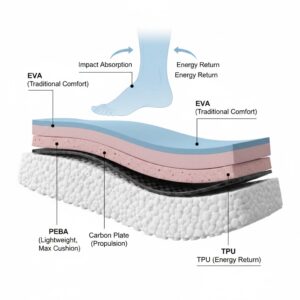
| Foam Type | Key Features (The “Why You Care”) | Common Feeling |
| EVA (Ethylene Vinyl Acetate) | The traditional, cheapest foam. Lightweight, but less durable and tends to compress and lose its bounce faster. | Soft and simple. A classic, comfortable feel, but it can get stiffer in the cold. |
| TPU (Thermoplastic Polyurethane) | More durable and longer-lasting than EVA. It offers better energy return and is less affected by temperature changes. (Often known by brand names like Boost or NRGY). | Bouncy and firm. Offers a lot of push-back energy for a more lively ride. |
| PEBA (Polyether Block Amide) | The modern, premium foam used in high-end shoes. Extremely lightweight, very soft, and highly responsive (great energy return, up to $\mathbf{85\%}$). (Often known by brand names like ZoomX or specific proprietary foams). | Lightweight and plush. Feels soft when you land but immediately gives you a strong, fast push-off. Less durable for daily, long-term use than TPU or standard EVA. |
B. The Stability Features (Controlling Movement)
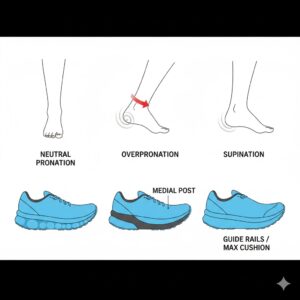
Not all feet land straight. If your foot rolls too far inward after impact (called overpronation), you need stability features built into the midsole.
Neutral Shoes: Designed for feet that land with ideal alignment. They focus purely on maximum cushioning.
Stability Shoes: Include a medial post (a firmer, denser piece of foam or plastic on the inside/arch side of the shoe) or Guide Rails (foam walls that cradle the foot) to slow down the inward roll of the foot, helping to align the knee and ankle.
Motion Control Shoes: The most rigid type, built for severe overpronation or for heavier runners who need maximum, uncompromising control.
1.2 The Outsole: Your Connection to the Ground
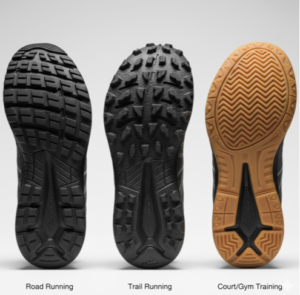
This is the rubber part that touches the floor. Its job is simple: grip and durability.
Road Running: Usually made of durable, slightly smoother carbon rubber with shallow patterns. The goal is long life and light weight.
Trail Running: Features deep, aggressive lugs (small rubber studs) for traction on mud, rocks, and uneven surfaces.8 Trail outsoles are often stickier and more protective against debris.
Court/Gym Shoes: Have flat, non-marking rubber outsoles with a tread pattern designed for quick, controlled lateral (side-to-side) cuts and stops.
1.3 The Upper: The Foot’s Secure Hug
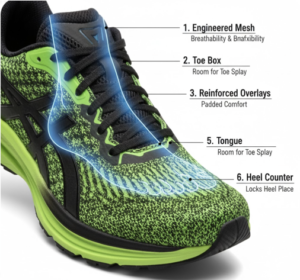
The upper is everything above the sole. Its purpose is to comfortably hold your foot in place.
Materials: Most modern shoes use lightweight, breathable engineered mesh to keep your feet cool and prevent chafing and blisters.
Toe Box: This must be roomy enough to allow your toes to splay naturally (spread out) when you push off.11 A cramped toe box is a quick path to bruised toes and blisters.
Heel Counter: A firm, often semi-rigid cup inside the back of the shoe that cradles and secures your heel.12 A good heel counter prevents heel slippage, which is a common cause of discomfort.
2. The Advanced Tech: Heel Drop and Carbon Plates
Beyond the basics, two modern elements play a huge role in how a shoe feels and performs.
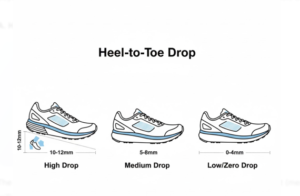
A. Heel-to-Toe Drop (The Slope)
The heel drop is the difference in height between the heel and the forefoot (measured in millimeters, or mm).
High Drop (10-12mm): Traditional shoe design. Encourages a heel-first landing and may relieve stress on the Achilles tendon and calves, making it good for runners with tight lower leg muscles.
Medium Drop (5-8mm): A modern balance that appeals to most runners.
Low Drop (0-4mm): Mimics a more natural, barefoot stride, encouraging a midfoot or forefoot landing.15 This can be great for running form, but it requires a much stronger calf and Achilles and should be introduced slowly to prevent injury.
B. Carbon Plates (The Spring)
You hear a lot about carbon plates in high-performance running shoes.
What it is: A thin, stiff plate of carbon fiber embedded within the midsole foam.
What it does: It acts like a lever or a spring. When you compress the foam and the plate, the plate straightens, offering a strong, propulsive snap at toe-off. This makes the shoe feel stiffer and faster, improving your running economy (how much oxygen you use at a given speed).
Who needs it: Mostly competitive runners and marathon racers. They are generally not necessary for walking, gym work, or casual daily runs, and can sometimes be too stiff for a beginner’s mechanics.
3. The Ultimate Fit Test: Comfort Trumps All Science
While pronation and foam type are important, the most critical piece of advice from modern sports science is surprisingly simple: If the shoe isn’t comfortable the moment you put it on, it is the wrong shoe.
Recent research has shown that when a shoe feels subjectively comfortable to an athlete, they are more likely to adopt a natural, efficient movement pattern. This self-selected comfort is a better predictor of injury prevention than being strictly prescribed a shoe based only on your arch type.
Your 5-Point Comfort Checklist:
The Thumb Space Rule: Make sure there is a gap of about one thumb’s width between the tip of your longest toe (often the second one, not the big toe) and the end of the shoe.18 This accommodates the slight swelling and sliding that happens during activity.
No Pinching: The widest part of your foot (the ball of the foot/metatarsals) should align with the widest part of the shoe. If it pinches on the sides, you need a wider size (look for “2E” or “4E” sizing).
The Heel Lock Test: Use the extra shoelace holes (the ones near the ankle collar) to create a “runner’s knot” or “heel lock” lacing pattern. Your heel should feel secure and not slip up and down, which prevents blisters.
Test It Out: Never buy a sports shoe without walking, jogging, or doing a few light jumps in the store. The shoe should not feel like something you have to “break in.”
Timing is Key: Shop for shoes in the late afternoon or evening, as your feet naturally swell throughout the day and will be at their largest size then.
4. Sport-Specific Shoes: Why You Need More Than One Pair
You wouldn’t use a screwdriver to hammer a nail. Similarly, you shouldn’t use a running shoe for basketball. Each sport demands different types of support.
A. Road Running Shoes (The All-Rounder)
Focus: Forward motion, shock absorption, light weight.
Must-Have: Responsive cushioning (EVA, TPU, or PEBA foam) and a breathable upper.
Problem Solved: Reduces repetitive stress on joints during long-distance training.
B. Trail Running Shoes (The Off-Road Warrior)
Focus: Grip, stability on uneven ground, durability.
Must-Have: Aggressive, deep lugs on the outsole for traction; a rock plate (a thin layer of plastic) in the midsole for protection from sharp stones; and a reinforced upper.
Problem Solved: Prevents falls, sprains, and punctures on challenging terrain.
C. Cross-Training/Gym Shoes (The Multi-Tasker)
Focus: Lateral stability (side-to-side support), flat base for lifting.
Must-Have: A flatter, slightly firmer sole (less cushion is often better for lifting) and excellent midfoot/lateral support to lock the foot in place during quick cuts and jumps.
Problem Solved: Prevents ankle rolling during side lunges, burpees, and agility drills, and provides a stable platform for squats and deadlifts. Never use a high-cushioned running shoe for heavy weightlifting.
D. Court Shoes (Basketball, Tennis, Badminton)
Focus: Ankle protection, quick stops, and pivoting.
Must-Have: A high-top or mid-cut design for ankle support; a durable, low-profile outsole with excellent grip for immediate stops; and a reinforced toe cap (for tennis/squash).
Problem Solved: Locks the foot and ankle in place to handle the extreme forces of sudden changes in direction.
5. Maintenance and Replacement: Extending the Life of Your Tool
Even the best-engineered shoe has a limited life. Ignoring the signs of wear is a direct path back to injury.
5.1 When to Replace Your Shoes (The Mileage Rule)
Running Shoes: Generally, replace them every 300 to 500 miles. If you run 20 miles a week, that’s about every 4 to 6 months.
Walking Shoes: Every 6 to 12 months of regular, daily use.
Visual Signs:
Creasing: Noticeable, permanent wrinkles in the midsole foam, especially on the inner side (where your arch is). This means the foam has compressed and lost its cushioning power.
Worn Tread: The outsole treads have worn flat, especially on the heel or forefoot. You’ll lose grip and stability.
The Pain Test: You start getting small, persistent aches (in the shins, knees, or feet) that you didn’t have before. This is your body telling you the shoe’s protection is gone.
5.2 Simple Maintenance Tips
Air Dry Only: Never put your shoes in a washing machine or dryer. Heat degrades the midsole foam quickly. If they get wet, stuff them with newspaper and let them air dry in a cool place.
Loosen the Laces: When taking off your shoes, always loosen the laces. Forcing your foot out damages the heel counter and compromises the overall fit.
Use Them for Their Purpose: Don’t use your high-tech running shoes for gardening, mowing the lawn, or casual errands. Keep them for your intended activity to preserve the midsole’s lifespan.
Frequently Asked Questions (FAQ)
Q1: Can I use my gym/cross-training shoes for walking?
A: Yes, generally. Gym shoes provide moderate cushioning and good stability, which is perfectly fine for low-impact walking. However, if you plan to walk very long distances (5+ miles), a dedicated walking or highly cushioned road running shoe might offer better long-term comfort.
Q2: What is the “wet test” for foot arch? Is it reliable?
A: The wet test involves wetting your foot and stepping onto a paper bag to see your footprint.20 While it can show you the shape of your arch (flat, neutral, high), it is not considered a reliable way to pick a shoe. It tells you the shape of your foot when standing, not how your foot moves when running or walking. A gait analysis at a specialty store is much better, or simply picking a shoe that feels comfortable (as noted in Section 3).
Q3: Why do some experts now say that “minimalist” or “barefoot” shoes are better?
A: Minimalist shoes promote a more natural, midfoot/forefoot striking pattern, which can strengthen the foot muscles and lower leg. However, they demand a long, gradual transition (often months) and are not suitable for everyone, especially those with pre-existing injuries or those who are high-mileage runners. For most people, a modern, cushioned shoe is the safer, more comfortable option.
Q4: If I buy a good quality shoe, will it prevent all my injuries?
A: No. While the right shoe is an essential piece of the puzzle, most injuries are caused by poor training habits: increasing mileage/intensity too quickly, lack of strength training, and inadequate rest.21 The shoe supports your movement, but your training plan is what protects you.
Disclaimer Policy
The content of this guide is intended to provide helpful, general information regarding sports shoe selection and should be used only as a starting point. It is not a substitute for medical advice, professional diagnosis, or treatment.
If you are experiencing pain, discomfort, or have a pre-existing injury (such as plantar fasciitis, knee pain, or a chronic ankle issue), you must consult with a qualified professional, such as a physical therapist, sports medicine physician, or podiatrist, before changing your footwear or exercise routine.
Shoe recommendations, including types of cushioning, drop, and stability features, are based on established biomechanical concepts. However, every individual’s body, foot mechanics, and reaction to footwear are unique. The ultimate responsibility for choosing the correct shoe, and assessing its suitability, rests with the user, ideally in consultation with a qualified footwear specialist and healthcare provider. Do not rely solely on this or any online guide to treat or diagnose any medical condition.
About Me

Our Search Engine is a marketplace where you can easily buy guest posts from high-quality websites and sell guest post opportunities on yours.-


- Automotive (9)
- Business (77)
- Celebrity (14)
- Construction (3)
- Digital Marketing (30)
- Education (34)
- Entertainment (210)
- Event (1)
- Finance (9)
- FOOD (6)
- Full Form (10)
- Gadgets (3)
- Health (93)
- Home Improvement (25)
- Internet (2)
- Jewellery (3)
- Law (2)
- lifestyle (42)
- Loan (2)
- News (4)
- Other (409)
- Real Estate (2)
- Services (5)
- Shopping (10)
- Social Media (3)
- Software (1)
- Sports (4)
- Technology (54)
- Uncategorized (6)